Introduction
A team integrates a state-of-the-art language model into their application.
The demo is impressive.
The prompts are carefully tuned. The outputs look almost magical. Stakeholders are excited, and the feature ships to production.
For a few days, everything feels like a success.
Then reality shows up.
Users start reporting inconsistent answers. The same question produces different outputs depending on phrasing. Some responses hallucinate facts with absolute confidence. Latency spikes during peak traffic. API costs exceed estimates. Edge cases begin surfacing faster than the team can patch them.
Nothing “broke” in the traditional sense.
The model is still working exactly as designed.
The problem is: production reality is not a demo environment.
This is the moment many teams realize a hard truth:
Shipping an AI feature is not a model problem. It is a systems engineering problem.
Choosing a powerful model is only the starting point. Once real users interact with it, you are no longer dealing with a static component you are operating a dynamic system that behaves probabilistically, evolves with usage patterns, and fails in non-deterministic ways.
This article walks through what actually happens after model selection and what it takes to turn an AI model into a reliable, production-grade product.
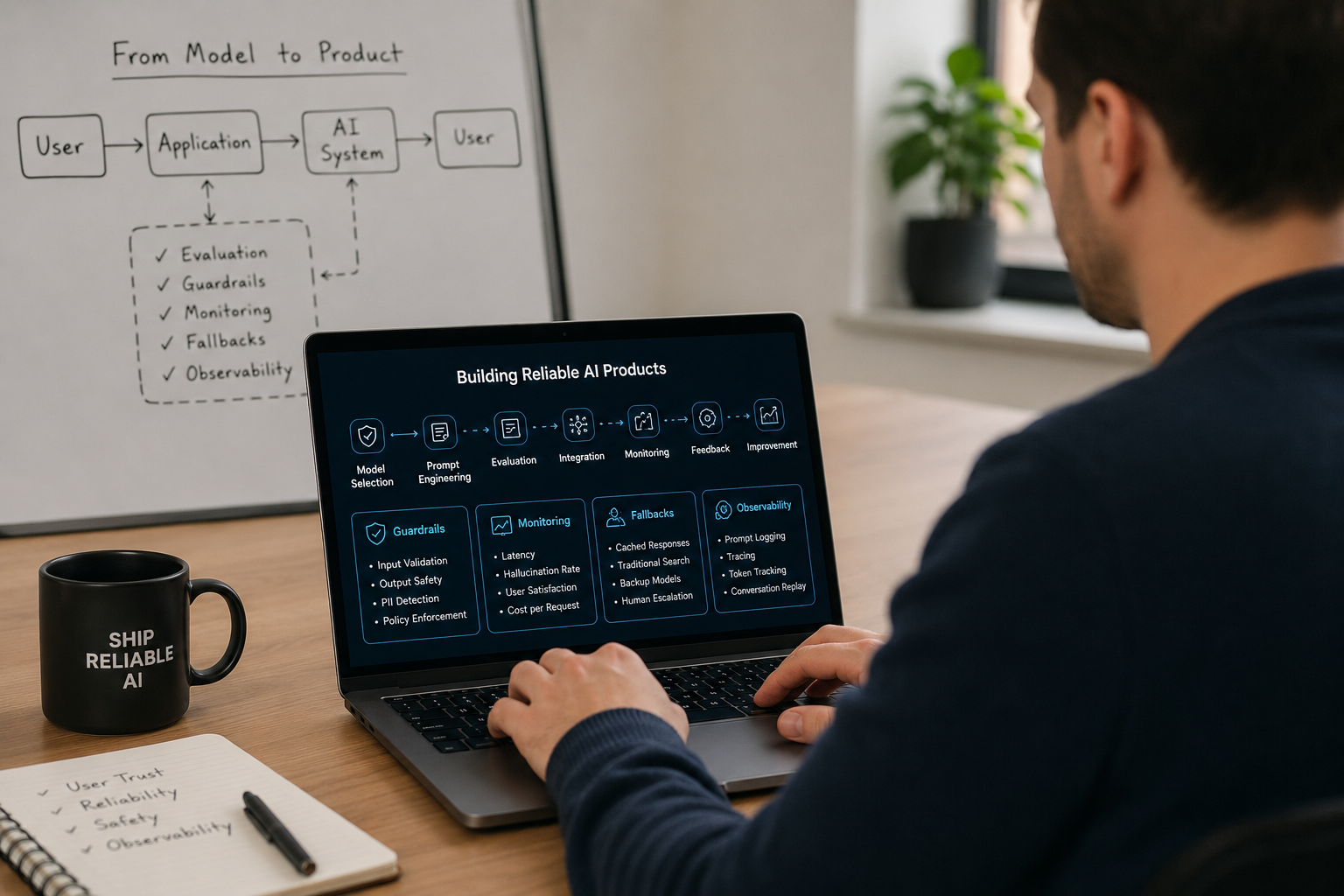
1. A Model Is Not a Product
A language model, at its core, is just a function:
- It takes input
- Produces output
- Optimizes for likelihood, not correctness
That’s it.
It can:
- Generate text
- Summarize content
- Answer questions
- Transform formats
But a product is something very different.
A production AI system must:
- Be reliable under unpredictable inputs
- Handle failures gracefully
- Provide consistent user experiences
- Protect users from harmful or misleading outputs
- Operate within latency and cost constraints
- Be observable and debuggable
A model is a single component.
A product is a system.
That system usually includes:
- A model (or multiple models)
- Prompt orchestration layer
- Retrieval systems (RAG or databases)
- Safety filters
- Evaluation pipelines
- Logging and observability infrastructure
- Fallback and routing logic
- Human escalation paths
If you deploy only the model, you are not shipping a product you are exposing an experiment to users.
2. Understanding the AI Product Lifecycle
AI features do not go from “idea → deployment” in a single jump. They follow a lifecycle that is iterative and continuously evolving.
A typical production lifecycle looks like this:
1. Model Selection
Choosing the base model based on:
- capability
- latency
- cost
- context limits
- stability across tasks
2. Prompt Engineering
Designing prompts that:
- constrain behavior
- improve consistency
- align outputs with product requirements
3. Evaluation
Testing behavior before users ever see it.
4. Integration
Embedding the model into real product workflows:
- APIs
- backend services
- UI constraints
5. Monitoring
Observing real-world behavior once exposed to users.
6. User Feedback Loop
Capturing:
- explicit feedback
- implicit signals (retries, edits, abandonment)
7. Continuous Improvement
Updating:
- prompts
- evaluation sets
- routing logic
- fallback strategies
- sometimes even the model itself
This lifecycle never truly ends.
Unlike traditional software, AI systems don’t “ship and stabilize.” They evolve continuously because both the model behavior and user expectations shift over time.
3. Evaluation Comes Before Deployment
One of the most common production mistakes is assuming that benchmark scores or offline accuracy are enough to ship.
They are not.
Benchmarks tell you how a model behaves on generic tasks. Production tells you how it behaves on your users, your data, and your edge cases.
What production-grade evaluation actually looks like:
Domain-specific evaluation sets
You need test cases that reflect real user behavior:
- actual queries from logs
- representative edge cases
- adversarial prompts
- multi-turn conversations
Regression testing
Every prompt or model change should be tested against:
- previous failure cases
- expected outputs
- golden responses
Prompt evaluation
Small prompt changes can significantly alter:
- tone
- correctness
- verbosity
- safety behavior
Human evaluation
Some things cannot be measured automatically:
- helpfulness
- clarity
- trustworthiness
- correctness in ambiguous contexts
The key insight:
If you can't evaluate it consistently, you shouldn't deploy it confidently.
In production AI systems, evaluation is not a pre-launch checklist. It is an ongoing engineering discipline.
Because once users start interacting with your system, every failure becomes part of your product behavior in the real world.
4. Monitoring AI Systems in Production
Traditional software monitoring answers questions like:
- Is the service available?
- Are requests succeeding?
- How long does each request take?
These metrics remain essential for AI applications, but they only tell part of the story.
An AI system can return an HTTP 200 response in under a second and still provide a completely useless answer.
Unlike traditional applications, success isn't binary. A request may technically succeed while failing the user.
That's why production AI requires monitoring at two levels:
- System health
- Model behavior
Both are equally important.
Traditional Infrastructure Metrics
Every AI service should still monitor the fundamentals.
Latency
Users are surprisingly sensitive to response time.
A five-second wait for a thoughtful answer might feel acceptable.
A five-second wait for a wrong answer feels unbearable.
Track latency across multiple dimensions:
- End-to-end request time
- Model inference time
- Retrieval latency
- Tool execution latency
- Time spent in safety pipelines
Breaking latency into stages makes bottlenecks much easier to identify.
Availability
Users don't care whether the model provider is experiencing an outage.
They only know your product isn't working.
Track:
- uptime
- failed requests
- timeout rate
- provider availability
- retry frequency
If a provider experiences intermittent failures, your users shouldn't notice.
Error Rates
Traditional failures still exist:
- API failures
- Authentication errors
- Network issues
- Rate limits
- Database failures
But AI introduces new classes of "soft failures" where everything technically succeeds while the experience degrades.
Throughput
Understand how many requests your infrastructure can handle under load.
Monitor:
- requests per second
- concurrent conversations
- queue lengths
- autoscaling behavior
High throughput with increasing latency is often an early warning sign that your AI infrastructure is approaching its limits.
AI-Specific Metrics
Traditional dashboards aren't enough.
You also need to understand how well the AI itself is performing.
Hallucination Rate
Hallucinations are one of the biggest sources of user distrust.
You won't catch every hallucination automatically, but you can estimate trends by measuring:
- user corrections
- regenerated responses
- fact-check failures
- manual review samples
- retrieval mismatches
A sudden increase usually signals:
- prompt regressions
- retrieval issues
- model updates
- domain drift
Response Quality
Quality isn't a single metric.
It usually combines several signals:
- user ratings
- follow-up questions
- conversation abandonment
- successful task completion
- human review scores
For example:
If users consistently ask,
Can you explain that again?
your AI may technically answer correctly while communicating poorly.
Refusal Rate
Models should refuse dangerous or unsupported requests.
But excessive refusals frustrate legitimate users.
Track:
- valid refusals
- unnecessary refusals
- policy-trigger frequency
An increasing refusal rate may indicate overly aggressive safety prompts or guardrails.
Token Usage
Tokens directly impact cost.
Monitor:
- average prompt size
- average completion size
- tokens per conversation
- retrieval token overhead
Small prompt optimizations can significantly reduce monthly expenses.
Cost Per Request
A successful AI feature also needs to make financial sense.
Instead of monitoring only total spending, monitor:
- average cost per request
- cost per successful task
- cost per active user
- cost by feature
Sometimes a slightly less capable model produces nearly identical user satisfaction at half the operational cost.
Engineering is often about finding the best trade-off, not chasing the highest benchmark score.
Prompt Failure Rate
Not every prompt produces usable output.
Track scenarios where responses:
- violate formatting
- fail validation
- contain incomplete information
- exceed token limits
- trigger retries
Prompt failures often increase gradually before becoming obvious to users.
Monitoring them early prevents larger production issues.
Model Drift
Models evolve.
User behavior evolves.
Business requirements evolve.
Even if your prompt never changes, performance can shift over time due to:
- provider updates
- changing user expectations
- new product features
- evolving datasets
Continuous monitoring helps detect these subtle changes before they become support tickets.
5. Guardrails: Protecting the User
Guardrails sometimes get a bad reputation.
People imagine them as restrictions that make AI less capable.
In reality, guardrails make AI more reliable.
Think about seatbelts in a car.
They don't reduce the engine's power.
They simply make driving safer.
AI guardrails serve the same purpose.
They reduce risk while preserving usefulness.
A production AI system should validate both what goes into the model and what comes out of it.
Input Guardrails
Before sending a prompt to the model, ask:
Should this request even reach the model?
Input guardrails help answer that question.
Prompt Validation
Ensure required fields exist.
Reject malformed requests.
Enforce maximum input lengths.
Normalize inconsistent formatting.
Simple validation prevents unnecessary failures downstream.
Abuse Detection
Public AI systems inevitably receive abusive inputs.
Examples include:
- spam
- automated attacks
- offensive language
- prompt flooding
Detecting these requests early protects both your infrastructure and your users.
Malicious Prompt Filtering
Prompt injection has become one of the most common attack vectors against LLM-powered applications.
Attackers may attempt to:
- override system instructions
- reveal hidden prompts
- access confidential data
- manipulate tool usage
Input filters should identify suspicious patterns before the request reaches the model.
No filter is perfect, but layered defenses dramatically reduce risk.
Output Guardrails
Even good prompts sometimes produce bad outputs.
Never assume the model's first response is safe to display directly to users.
Treat every output as untrusted until it passes validation.
Toxicity Detection
Generated text should be checked for:
- abusive language
- hate speech
- harassment
- inappropriate content
This is especially important for consumer-facing applications.
Personally Identifiable Information (PII) Filtering
Models can accidentally expose sensitive information.
Output filters should detect and redact:
- email addresses
- phone numbers
- government IDs
- financial information
- internal identifiers
Protecting user privacy isn't optional it's a core product responsibility.
Structured Output Validation
Many AI systems are expected to return structured formats such as:
- JSON
- XML
- SQL
- Markdown
- API payloads
Never trust the model to produce perfectly formatted output every time.
Validate the structure before passing it to downstream systems.
A malformed JSON response should trigger a retry or fallback not a production incident.
Factual Verification
Some responses deserve additional scrutiny.
For high-impact use cases, verify outputs against trusted sources before presenting them.
Examples include:
- financial information
- medical guidance
- legal summaries
- inventory data
- pricing
- policy documents
The goal isn't to eliminate hallucinations entirely.
It's to prevent incorrect information from reaching users unchecked.
Policy Enforcement
Every product has its own rules.
An educational platform, healthcare application, and enterprise assistant all have different requirements.
Policy enforcement ensures responses align with:
- company policies
- legal requirements
- compliance obligations
- product guidelines
The model generates possibilities.
Your product decides which possibilities are acceptable.
The most effective AI systems don't rely on a single safety mechanism.
They combine multiple layers:
User Input
      │
      ▼
Input Validation
      │
      ▼
Abuse Detection
      │
      ▼
Prompt Processing
      │
      ▼
Language Model
      │
      ▼
Output Validation
      │
      ▼
Safety Filters
      │
      ▼
Structured Validation
      │
      ▼
User Response
Each layer catches a different class of failures.
Individually, they reduce risk.
Together, they build trust.
Why Guardrails Increase Trust
There's a common misconception that removing guardrails makes AI "more intelligent."
The opposite is usually true in production.
Users don't judge intelligence based on how often a model answers.
They judge it based on whether they can trust those answers.
An assistant that occasionally says,
I'm not confident enough to answer that.
often earns more credibility than one that confidently fabricates information.
Reliability isn't about answering every question.
It's about answering responsibly.
Guardrails don't limit great AI products.
They make great AI products possible.
6. Designing Effective Fallbacks
One of the biggest misconceptions about AI systems is the assumption that the model will always produce a useful response.
It won't.
Sometimes the model times out. Sometimes it exceeds rate limits. Sometimes it refuses a perfectly valid request. Sometimes it generates an answer that fails validation. And occasionally, external dependencies retrieval systems, APIs, or databases fail before the model even has a chance to respond.
Production systems are built with the expectation that failures will happen.
The question isn't if your AI feature will fail.
It's how gracefully it fails.
Users are surprisingly forgiving when an application is transparent about its limitations. They're far less forgiving when it confidently behaves unpredictably.
A well-designed fallback strategy transforms failures into manageable user experiences.
Cached Responses
Not every question requires fresh inference.
Many applications repeatedly receive the same requests:
- "How do I reset my password?"
- "What are your business hours?"
- "How do I update my billing information?"
Instead of invoking an LLM every time, cache high-confidence responses for frequently asked questions.
Benefits include:
- Lower latency
- Reduced API costs
- Consistent answers
- Increased reliability during traffic spikes
Caching is one of the simplest optimizations, yet it's often overlooked in early AI implementations.
Traditional Search
Sometimes retrieval is better than generation.
If a user is looking for an exact policy, product specification, or documentation page, a deterministic search result is often more valuable than a generated summary.
A practical workflow might look like this:
- Search the knowledge base.
- If confidence is high, return the relevant result.
- If confidence is low, ask the language model to summarize or explain it.
This approach combines the precision of search with the flexibility of generative AI.
Deterministic Business Logic
Not every decision should involve an LLM.
Business rules such as:
- discount calculations
- tax computation
- shipping eligibility
- account permissions
- subscription limits
should remain deterministic.
Using an LLM for logic that can be expressed with code introduces unnecessary uncertainty.
AI should enhance business workflows not replace well-defined rules.
Smaller Backup Models
Many production systems route requests dynamically.
For example:
- Use a larger model for complex reasoning.
- Use a lightweight model for simple classification.
- Switch to a backup model if the primary provider experiences an outage.
This strategy improves resilience while controlling operational costs.
The goal isn't to use the most powerful model for every request.
It's to use the most appropriate model for each request.
Asking Users for Clarification
Sometimes the best fallback is another question.
Consider the request:
Can you summarize the report?
Which report?
Instead of guessing, ask:
Could you tell me which report you're referring to?
Clarification reduces hallucinations, improves accuracy, and creates a more natural conversational experience.
Users generally appreciate thoughtful follow-up questions more than confident assumptions.
Graceful Degradation
Imagine an AI-powered document assistant.
Normally it:
- retrieves relevant files
- summarizes content
- answers follow-up questions
- generates action items
Now imagine the retrieval service is temporarily unavailable.
A poor experience might return:
Internal server error.
A better experience might say:
I'm unable to access your documents right now, but I can still answer general questions or help explain concepts.
The feature doesn't disappear it adapts.
Graceful degradation preserves user trust even when parts of the system are unavailable.
Human Escalation
Some situations simply require a person.
Examples include:
- disputed financial transactions
- legal decisions
- healthcare guidance
- sensitive customer support issues
- high-value enterprise workflows
Rather than forcing the AI to answer everything, escalate when confidence falls below an acceptable threshold.
The smartest AI products know when to involve humans.
Reliability Over Intelligence
One lesson consistently emerges in production systems:
Users prefer predictable behavior over impressive demos.
A slightly less capable assistant that behaves consistently earns far more trust than a brilliant assistant that occasionally behaves unpredictably.
Reliability compounds.
Every dependable interaction increases user confidence.
Every surprising failure decreases it.
7. Humans Are Still Part of the System
Despite rapid advances in AI, humans remain an essential component of many production workflows.
This isn't a limitation.
It's good engineering.
Some decisions carry enough risk that automation alone isn't appropriate.
The most successful AI products understand where human expertise adds value.
Human-in-the-Loop Systems
Human-in-the-loop (HITL) systems combine AI efficiency with human judgment.
Instead of replacing people, AI assists them.
Common examples include:
Content Moderation
AI can flag potentially harmful content.
Human moderators make the final decision.
This dramatically reduces review workload while maintaining quality.
Customer Support
AI drafts responses.
Support agents review, edit, and approve them before sending.
Agents spend less time writing repetitive replies while retaining full control.
Legal Review
AI summarizes contracts.
Lawyers validate the conclusions.
The AI accelerates analysis without becoming the source of legal authority.
Healthcare Assistance
AI organizes patient information and suggests possible diagnoses.
Medical professionals make the final clinical decisions.
The AI supports expertise it doesn't replace it.
Confidence-Based Routing
Many production systems estimate confidence before deciding whether AI should respond independently.
For example:
High Confidence
        │
        ▼
Automatic Response

Medium Confidence
        │
        ▼
Ask User for Clarification

Low Confidence
        │
        ▼
Escalate to Human
Confidence-based routing reduces costly mistakes while preserving automation for routine cases.
AI as a Copilot
One of the most successful product patterns isn't autonomous AI.
It's collaborative AI.
Rather than replacing experts, AI becomes a copilot that:
- drafts
- summarizes
- organizes
- recommends
- retrieves information
Humans remain responsible for final decisions.
This partnership combines computational speed with human judgment.
8. Observability Beyond Logs
Traditional applications generate logs that answer questions like:
- What endpoint failed?
- Which database query timed out?
- Which exception occurred?
AI systems require much richer observability.
When a user reports:
The assistant gave me a strange answer.
A stack trace won't explain why.
You need to reconstruct the entire interaction.
Prompt Logging
Every production AI system should record:
- system prompts
- user prompts
- retrieved context
- model parameters
- prompt versions
Without this information, reproducing failures becomes nearly impossible.
Be mindful to handle sensitive user data responsibly by applying appropriate privacy controls, redaction, and retention policies.
Response Tracing
A single answer may involve multiple steps:
- retrieval
- tool execution
- multiple model calls
- validation
- formatting
Tracing each stage helps identify where failures occur.
For example:
User Question
      │
      ▼
Document Retrieval
      │
      ▼
Context Assembly
      │
      ▼
Model Generation
      │
      ▼
Output Validation
      │
      ▼
Final Response
If the final answer is incorrect, tracing helps determine whether the issue originated from retrieval, prompting, validation, or the model itself.
Token Tracking
Tokens affect both performance and cost.
Track:
- prompt tokens
- completion tokens
- total conversation tokens
- retrieval overhead
- tool-generated context
Unexpected token growth often indicates prompt bloat or inefficient context management.
Small optimizations can significantly reduce monthly operating costs.
Conversation Replay
Bug reports often sound like this:
The AI became confused after a few messages.
Without conversation history, reproducing the issue is nearly impossible.
Conversation replay allows engineers to reconstruct interactions exactly as they occurred.
This is especially valuable for debugging multi-turn conversations where context accumulates over time.
Again, ensure replay systems respect user privacy and organizational data governance requirements.
Model Version Tracking
Models change.
Providers release updates.
Prompts evolve.
Routing logic changes.
Without version tracking, it's difficult to answer a simple question:
What changed?
Every request should include metadata such as:
- model version
- prompt version
- retrieval pipeline version
- application release version
- feature flag configuration
This information dramatically reduces debugging time.
Latency Analysis
Total latency rarely tells the whole story.
Break requests into stages:
- network latency
- retrieval latency
- model inference
- validation
- post-processing
Visualizing latency by component makes optimization efforts much more targeted.
Observability Enables Continuous Improvement
Observability isn't only about debugging failures.
It also reveals opportunities.
You may discover:
- prompts that consistently produce better outcomes
- retrieval sources with higher accuracy
- unnecessary token usage
- expensive workflows with little user value
- edge cases that deserve dedicated evaluation
Good observability transforms anecdotal feedback into actionable engineering insights.
It allows teams to improve products based on evidence rather than intuition.
9. Common Production Mistakes
The first version of an AI feature is rarely the hardest part.
Keeping it reliable after thousands or millions of real user interactions is where the real engineering begins.
Over time, a handful of production mistakes appear again and again. They're usually not caused by poor models, but by treating AI systems like traditional software components.
Let's look at some of the most common ones.
Deploying Without Evaluation
It's tempting to test a handful of prompts, see impressive responses, and move straight to production.
After all, if it works in the demo, why wouldn't it work for users?
Because demos are curated.
Production isn't.
Real users ask incomplete questions, use unexpected terminology, make spelling mistakes, and explore edge cases that never appeared during internal testing.
Without a structured evaluation process, every production deployment becomes an uncontrolled experiment.
A robust evaluation suite should answer questions like:
- Does the model still solve our primary use cases?
- Did a prompt update introduce regressions?
- Are previously fixed issues returning?
- How does performance compare across different user personas?
Evaluation isn't a one-time milestone. It's an ongoing safety net.
Ignoring Hallucinations
Hallucinations are often treated as rare anomalies.
In reality, they're an expected property of generative models.
The mistake isn't that hallucinations exist.
The mistake is assuming they'll never reach users.
If your product presents generated content as authoritative without verification, you're effectively asking users to distinguish fact from fiction themselves.
Whenever correctness matters, introduce validation layers:
- retrieval-backed generation
- confidence thresholds
- human review
- factual verification
- explicit uncertainty
Users don't expect perfection.
They do expect honesty.
Relying on a Single Model
Many first-generation AI products are tightly coupled to one provider and one model.
It feels simple.
Until it isn't.
What happens if:
- pricing changes?
- latency increases?
- context limits change?
- availability drops?
- another model becomes better suited for specific tasks?
Production systems benefit from abstraction.
Design your architecture so that routing, evaluation, and business logic remain independent of any specific model provider.
Models should be replaceable components, not hardcoded dependencies.
No Fallback Strategy
Every external dependency eventually fails.
Language models are no exception.
Without fallback mechanisms, even a temporary provider outage can render an entire feature unusable.
Instead, ask:
- Can we return cached information?
- Can we perform a deterministic search?
- Can we use a smaller backup model?
- Can we ask the user for clarification?
- Should we escalate to a human?
Failures are inevitable.
Poor user experiences are not.
Poor Monitoring
A surprising number of AI systems monitor only infrastructure metrics.
CPU usage.
Memory consumption.
HTTP status codes.
While important, these metrics don't tell you whether users are actually receiving useful responses.
If you aren't monitoring response quality, user satisfaction, hallucination trends, or token usage, you're only observing half the system.
Good monitoring answers two questions:
- Is the system healthy?
- Is the experience healthy?
Both matter.
Exposing Raw Model Outputs
One of the fastest ways to lose user trust is to display raw model output without validation.
Models can:
- produce malformed JSON
- invent citations
- leak sensitive information
- ignore formatting requirements
- generate unsafe content
Always treat model output as untrusted input.
Validate it.
Sanitize it.
Structure it.
Only then should it reach the user or downstream systems.
Assuming Prompts Never Need Maintenance
Traditional software often becomes more stable over time.
Prompts don't.
As products evolve, prompts gradually drift away from current requirements.
New features introduce additional context.
Business policies change.
Models receive provider updates.
User expectations evolve.
Prompt engineering isn't a one-time task.
It's an ongoing maintenance activity that benefits from versioning, testing, and regular review.
Small Problems Become Expensive at Scale
An occasional hallucination might seem harmless during internal testing.
Multiply that across hundreds of thousands of requests, and it becomes:
- support tickets
- customer frustration
- operational costs
- reputational damage
- engineering fire drills
Scale amplifies everything; both strengths and weaknesses.
Production engineering is largely the discipline of preventing small issues from becoming large incidents.
10. The Engineering Mindset for AI Products
Building AI-powered software requires a subtle but important shift in engineering philosophy.
Traditional software engineering is built around certainty.
AI engineering is built around probability.
That doesn't make AI systems less reliable.
It means reliability is achieved differently.
Traditional Software
In conventional applications, we expect deterministic behavior.
Given the same input, the software should produce the same output every time.
For example:
Input:
2 + 2

Output:
4
Anything else is a bug.
AI Systems
Generative models behave differently.
Given the same prompt, multiple valid responses may exist.
For example:
Summarize this meeting.
One response may be concise.
Another may be detailed.
Both could be correct.
Engineering shifts from guaranteeing exact outputs to designing acceptable behavior within well-defined boundaries.
Designing for Uncertainty
Rather than pretending uncertainty doesn't exist, production systems embrace it.
That means building:
- evaluation pipelines
- guardrails
- monitoring
- retries
- fallback strategies
- confidence estimation
- human escalation
Instead of asking:
How do we eliminate uncertainty?
Ask:
How do we manage uncertainty responsibly?
That mindset leads to more resilient systems.
Reliability Is an Ongoing Process
Traditional deployments often follow this pattern:
Build
      │
      ▼
Test
      │
      ▼
Deploy
      │
      ▼
Done
Production AI looks more like this:
Build
      │
      ▼
Evaluate
      │
      ▼
Deploy
      │
      ▼
Monitor
      │
      ▼
Collect Feedback
      │
      ▼
Improve
      │
      ▼
Evaluate Again
      │
      ▼
Deploy Again
The cycle never truly ends.
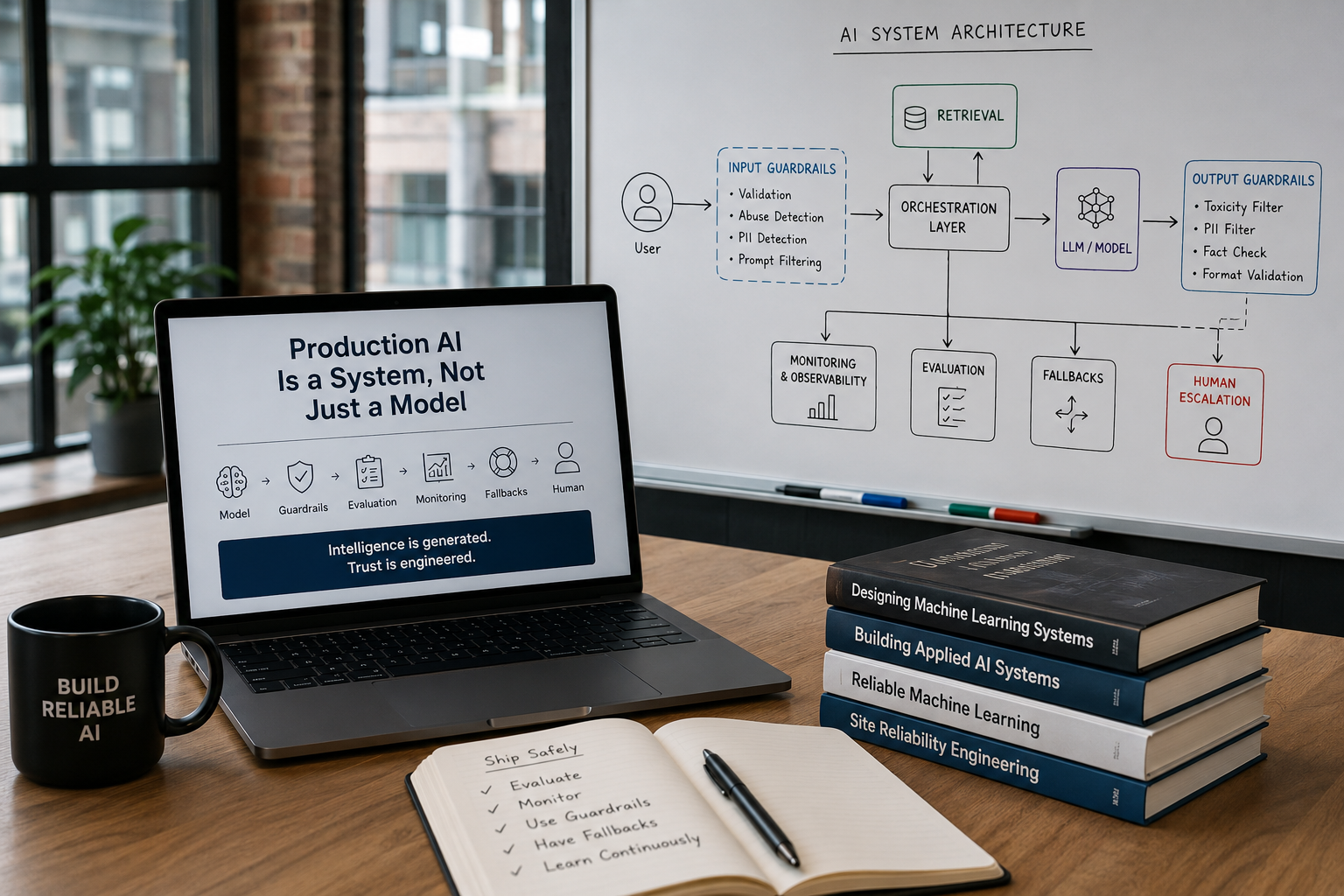
Your AI product is a living system that continuously learns not because the model automatically retrains, but because your engineering practices continuously improve how it is evaluated, orchestrated, and operated.
Trust Is the Real Product
Users rarely know which model powers your application.
They don't compare benchmark scores.
They remember whether the product helped them accomplish their task.
Trust is earned through:
- consistency
- transparency
- predictable behavior
- graceful failure
- continuous improvement
Those qualities come from engineering, not from model selection alone.
11. The Future of AI Engineering
As AI becomes a standard part of modern software, competitive advantage will shift.
Today, it's easy to focus on choosing the newest or largest model.
Tomorrow, nearly every team will have access to similar capabilities.
The differentiator won't be access to intelligence.
It will be the ability to operationalize it effectively.
Orchestration Over Single Calls
Future AI applications won't rely on a single prompt and a single model response.
Instead, they'll orchestrate multiple specialized components:
- retrieval systems
- planning agents
- reasoning models
- tool execution
- validation services
- workflow engines
The intelligence of the overall system will emerge from coordination rather than any individual model.
Evaluation Pipelines as Core Infrastructure
Evaluation will become as fundamental as automated testing.
Every prompt update, routing change, or model upgrade should automatically answer questions like:
- Did quality improve?
- Did latency increase?
- Did costs change?
- Were safety guarantees maintained?
Continuous evaluation will become a standard part of every deployment pipeline.
Observability by Default
Future engineering teams won't ask whether they should instrument AI systems.
They'll assume comprehensive observability from day one.
Every production request will be traceable, measurable, and explainable.
Diagnosing AI behavior should become as routine as debugging a web service.
Safety as a Product Feature
Safety won't be viewed as an optional compliance requirement.
It will become a core part of user experience.
Users trust products that:
- acknowledge uncertainty
- protect sensitive information
- behave consistently
- recover gracefully
- explain limitations honestly
In many cases, these qualities matter more than achieving marginal improvements on benchmark leaderboards.
Retrieval and Workflow Automation
Generative models are increasingly becoming one component within larger workflows.
Modern AI products combine:
- retrieval
- structured business logic
- APIs
- automation
- human collaboration
- domain-specific knowledge
The future belongs to systems that integrate these capabilities seamlessly rather than relying on generation alone.
Humans Will Continue to Matter
Despite remarkable advances, AI won't eliminate human expertise.
Instead, engineers will build systems that amplify it.
Doctors will diagnose with AI assistance.
Lawyers will review AI-generated summaries.
Support agents will resolve issues faster with AI copilots.
Software engineers will design increasingly intelligent platforms while remaining responsible for reliability, safety, and user trust.
The role of AI is not to replace good engineering.
It's to make good engineering even more impactful.
Conclusion
Selecting a powerful language model is exciting.
But it's also the easiest part of building an AI product.
The real challenge begins after the API integration is complete.
That's when engineering takes center stage.
Production AI isn't defined by impressive demos or benchmark scores.
It's defined by how well a system behaves when confronted with unpredictable users, evolving requirements, infrastructure failures, and the countless edge cases that only appear at scale.
Reliable AI products don't happen by accident.
They are the result of thoughtful engineering practices:
- rigorous evaluation
- continuous monitoring
- layered guardrails
- resilient fallback strategies
- comprehensive observability
- human oversight where appropriate
- relentless iteration based on real-world feedback
The language model generates intelligence.
The surrounding system determines whether that intelligence is useful, safe, and trustworthy.
At the end of the day, users don't judge your product by the sophistication of its underlying model.
They judge it by whether it consistently helps them solve problems.
That's why shipping an AI feature isn't the end of development.
It's the beginning of operating a living system.
One that requires continuous attention, continuous learning, and continuous improvement.
The best AI products are not the ones with the smartest models. They are the ones users can rely on every single day.
Final Thoughts
The AI industry moves quickly, and new models will continue to raise the ceiling of what's possible.
But as capabilities become increasingly accessible, engineering excellence will become the true competitive advantage.
The teams that succeed won't necessarily be the ones using the newest model.
They'll be the ones that build systems users trust systems that are observable, resilient, secure, and thoughtfully designed for the realities of production.
Because in the end, intelligence may attract users.
Reliability is what keeps them coming back.