Introduction
Over the last few years, prompt engineering has become one of the hottest topics in AI.
Open any social media platform or YouTube channel, and you'll find content like:
- "10 prompts every AI engineer should know."
- "Master prompting in 30 minutes."
- "The ultimate ChatGPT prompt template."
- "Prompt engineering is the future."
It's easy to see why. Prompt engineering is accessible, immediately rewarding, and anyone with access to an LLM can experiment with it.
But here's a question that often gets overlooked:
Is prompt engineering really where the difficult engineering work happens?
After building and deploying AI-powered applications in production, I've found that the answer is usually no.
Don't get me wrong; prompts matter. A well-crafted prompt can improve response quality, enforce formatting, and make interactions more consistent.
But once you move beyond demos and prototypes, you quickly realize that prompts account for only a small fraction of the engineering effort.
Production AI isn't primarily a prompting challenge.
It's a systems engineering challenge.
The difference is significant.
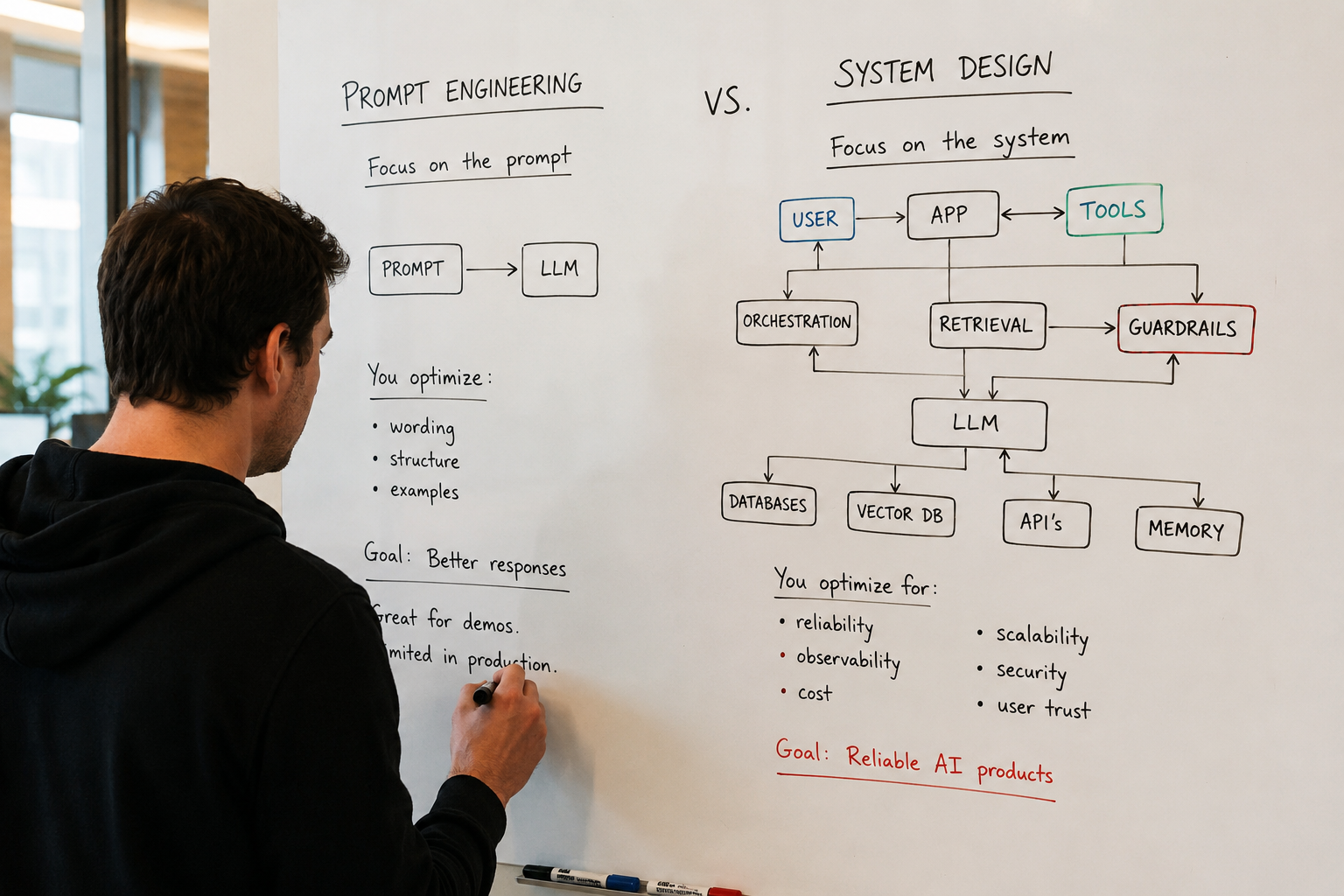
One focuses on making a single model response better.
The other focuses on building an AI product that remains reliable, scalable, observable, secure, and maintainable over thousands or even millions of interactions.
This article explores why the future of AI engineering belongs not just to people who write better prompts, but to engineers who build better systems.
1. What Prompt Engineering Actually Is
Prompt engineering is the process of designing instructions that help language models generate better outputs.
It involves providing the model with enough context and structure to increase the likelihood of receiving useful responses.
Common techniques include:
- Role prompting
- Few-shot examples
- Structured output requests
- Clear formatting instructions
- Step-by-step guidance where appropriate
- Context injection
For example, instead of asking:
Explain Kubernetes.
A better prompt might be:
Explain Kubernetes to a backend engineer transitioning from monolithic applications. Include one analogy and provide a comparison with Docker.
The second prompt gives the model additional context about:
- the audience
- the expected depth
- formatting expectations
The result is usually more useful.
Prompt engineering helps reduce ambiguity.
It guides the model toward the response you want instead of hoping it guesses correctly.
Engineering Insight: Prompt engineering improves communication with the model. It doesn't replace good software engineering.
2. Why Prompt Engineering Became So Popular
Prompt engineering exploded in popularity for several reasons.
First, it's incredibly accessible.
You don't need cloud infrastructure.
You don't need Kubernetes.
You don't need databases or deployment pipelines.
You simply open an AI chat interface and start experimenting.
Second, the feedback loop is immediate.
Change a sentence.
Run it again.
See different results.
That makes learning enjoyable.
Third, prompt improvements are easy to demonstrate.
A side-by-side comparison of two prompts can look dramatic in a social media post.
It's much harder to demonstrate improvements in:
- observability
- evaluation
- latency optimization
- monitoring
- caching
- failure recovery
Ironically, those are often the parts that determine whether an AI product succeeds in production.
3. The Limits of Prompt Engineering
At some point, every AI engineer discovers the limits of prompting.
You encounter problems that no amount of wording can solve.
For example:
Hallucinations
A prompt can encourage the model to be careful.
It cannot magically give the model access to information it doesn't know.
Latency
Changing a prompt won't reduce network latency or API response times.
Cost
Longer prompts often increase token usage rather than reducing it.
Permissions
Prompting cannot determine what data a user is actually allowed to access.
Long-Term Memory
No prompt creates persistent memory across sessions.
Observability
A prompt won't tell you why users abandon conversations or where failures occur.
Reliability
If your application crashes because an external service is unavailable, the prompt isn't the problem.
Your architecture is.
Engineering Insight: No prompt can compensate for poor system architecture.
4. What Real AI Engineering Looks Like
Production AI applications are much more than a language model.
A typical AI product includes:
- APIs
- Databases
- Authentication
- Vector databases
- Retrieval pipelines
- Business logic
- Caching
- Monitoring
- Analytics
- Logging
- Evaluation pipelines
- Background jobs
- Security layers
- Guardrails
The language model is just one component.
A useful analogy is a car.
The engine matters.
Without it, the car doesn't move.
But nobody buys a car based solely on the engine.
You also need:
- steering
- brakes
- suspension
- safety systems
- electronics
- tires
- navigation
The LLM is the engine.
The AI product is the entire vehicle.
A powerful engine doesn't automatically create a reliable car.
Likewise, a state-of-the-art language model doesn't automatically create a successful AI application.
5. Retrieval Is More Important Than Better Prompts
One of the biggest quality improvements in production AI often comes from retrieval rather than prompting.
Retrieval-Augmented Generation (RAG) allows applications to provide relevant information to the model before it generates a response.
Instead of relying only on what the model learned during training, the application supplies fresh, domain-specific context.
For example:
- internal documentation
- company policies
- product manuals
- customer records
- recent reports
This has several advantages:
- reduces hallucinations
- grounds responses in trusted sources
- keeps answers up to date
- improves enterprise accuracy
A customer support assistant with access to the latest documentation will usually outperform a perfectly prompted model that lacks current information.
Engineering Insight: Better context almost always beats clever prompting.
6. Orchestration Is Where AI Products Become Useful
Most useful AI products involve much more than a single model call.
They orchestrate multiple steps.
For example, a travel assistant might:
- Understand the user's intent.
- Search available flights.
- Retrieve hotel options.
- Check weather forecasts.
- Compare prices.
- Generate a personalized itinerary.
Similarly, a customer support assistant may:
- retrieve account details
- search internal documentation
- verify permissions
- call external APIs
- summarize results
- generate a response
The intelligence comes from coordinating multiple components not from one exceptionally crafted prompt.
This orchestration layer determines:
- when to call models
- when to use tools
- when to retrieve data
- when to ask follow-up questions
- when to stop
That coordination is what transforms an LLM into a useful product.
7. Guardrails Matter More Than Prompt Tricks
One of the biggest misconceptions in AI development is that prompts alone can ensure safe behavior.
In reality, trust comes from guardrails.
Common guardrails include:
- input validation
- output validation
- structured responses
- policy enforcement
- content filtering
- permission checks
- rate limiting
Imagine an internal HR assistant.
Even if the prompt instructs the model not to reveal confidential salaries, the application should still enforce access permissions before the request reaches the model.
Security belongs in software.
Not in prompts.
Engineering Insight: Users trust systems that behave predictably not systems with clever prompts.
8. Observability Makes AI Maintainable
Traditional software already benefits from logging and monitoring.
AI applications require even more visibility.
Useful metrics include:
- prompt versions
- model versions
- response latency
- token usage
- retrieval quality
- user feedback
- failure rates
- tool execution traces
Without observability, debugging becomes guesswork.
Imagine users reporting:
"The assistant gives strange answers every Tuesday."
Without logs or traces, finding the cause becomes nearly impossible.
Perhaps:
- a retrieval service failed
- an API timed out
- a prompt changed
- a new model version was deployed
You can't improve what you can't observe.
9. Evaluation Never Ends
Shipping an AI feature is not the finish line.
It's the beginning of continuous evaluation.
Unlike traditional software, AI behavior evolves.
Models change.
Prompts evolve.
Knowledge bases grow.
User expectations shift.
A robust evaluation process should include:
- regression testing
- prompt comparisons
- production feedback analysis
- automated benchmarks
- human review for critical workflows
Evaluation is not a one-time task.
It's an ongoing engineering discipline.
10. Fallbacks Make AI Reliable
Every production system eventually encounters failures.
AI applications are no exception.
When something goes wrong, users shouldn't experience a complete breakdown.
Instead, the system should degrade gracefully.
Common fallback strategies include:
- deterministic workflows
- traditional keyword search
- cached responses
- backup language models
- human escalation
- retry mechanisms
For example, if retrieval fails, the application might switch to a traditional search experience instead of displaying an error.
Users appreciate reliability far more than occasional brilliance.
Engineering Insight: Reliability is remembered long after impressive AI responses are forgotten.
11. Thinking Like a Systems Engineer
The biggest mindset shift isn't learning a better prompt template.
It's asking better engineering questions.
Instead of asking:
How do I write a better prompt?
Ask:
- How do I monitor this?
- How do I evaluate this?
- How do I reduce hallucinations?
- How do I recover from failures?
- How do I control costs?
- How do I improve latency?
- How do I keep this maintainable?
- How do I ensure users only see data they're authorized to access?
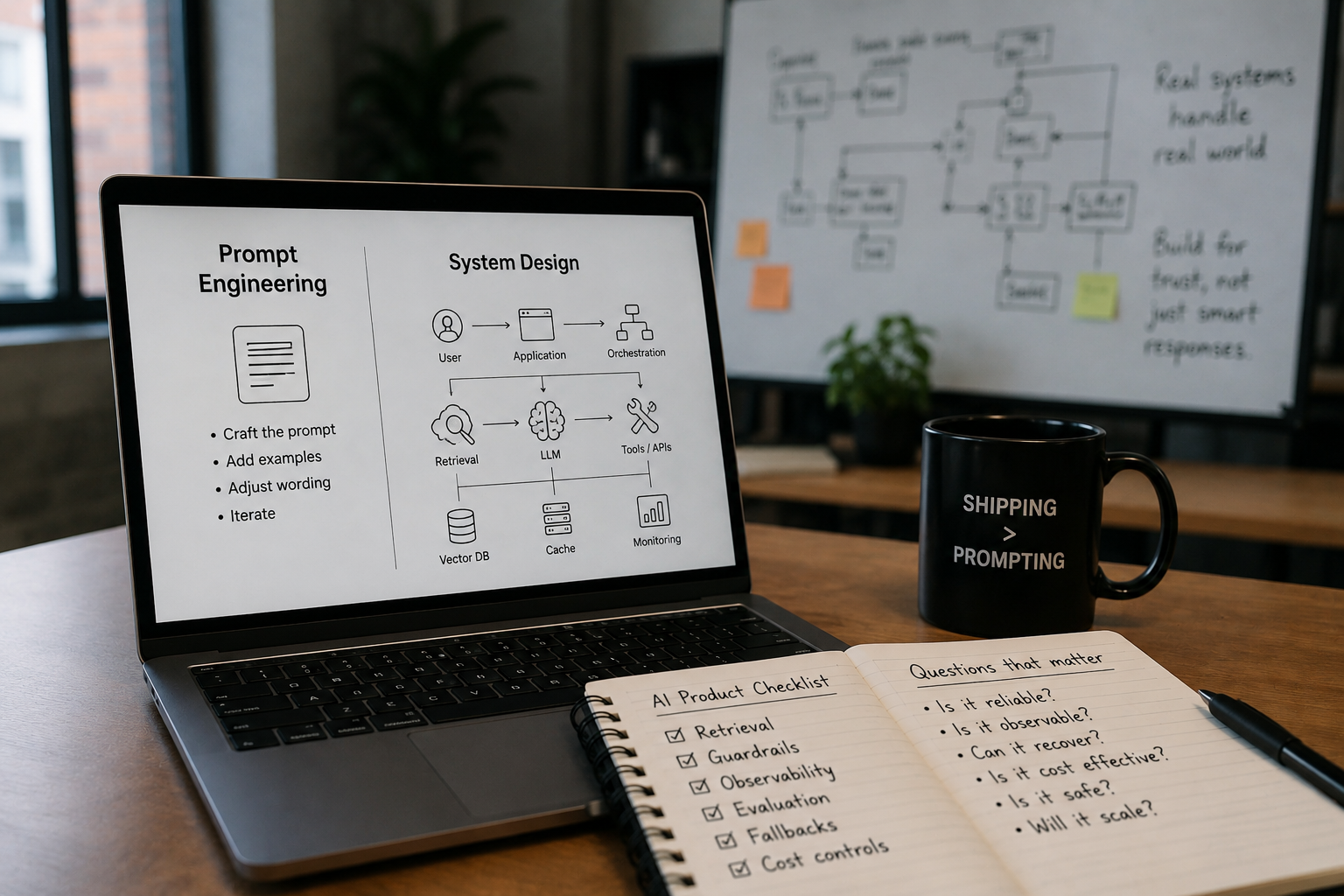
These questions define modern AI engineering.
They force us to think about the product as a whole rather than the model in isolation.
12. The Future of AI Engineering
Prompt engineering isn't disappearing.
It will remain an important skill.
But it will increasingly become just one piece of a much larger toolkit.
Future AI engineers will spend more time working on:
- architecture
- orchestration
- retrieval
- observability
- evaluation
- infrastructure
- safety
- scalability
- cost optimization
- reliability
The engineers who create the most impactful AI products won't necessarily write the most sophisticated prompts.
They'll design systems that consistently deliver value under real-world conditions.
Conclusion
Prompt engineering deserves its place in every AI engineer's toolkit.
Clear instructions, structured prompts, and thoughtful context all contribute to better model behavior.
But they are only one layer of the stack.
The real challenge begins when an AI feature needs to operate reliably for thousands of users, integrate with existing systems, respect permissions, recover from failures, remain observable, and continuously improve over time.
That's where system design takes center stage.
As AI products become more deeply embedded in everyday software, the most valuable engineers won't be those who can craft the perfect prompt.
They'll be the ones who can design reliable architectures, build resilient workflows, measure quality, manage trade-offs, and create systems that users can trust.
Because in the end, users don't judge your product by how clever your prompts are.
They judge it by whether it works.
Great prompts make impressive demos. Great systems build products people trust.