Introduction
“We optimized the algorithm… and nothing got faster.”
If you’ve been in this industry long enough, you’ve said that sentence out loud.
The team switched data structures.
Reduced loops.
Refactored “inefficient” code.
Added caching “just in case.”
Deploy.
No noticeable improvement.
Maybe 1–2%. Maybe noise. Sometimes it even got worse.
Here’s the uncomfortable truth:
Most performance optimizations fail because they’re based on guesses.
We optimize what looks slow.
We optimize what feels inefficient.
We optimize what we understand not what actually consumes time.
This post is about where performance really goes in modern systems and what actually moves the needle when things are slow.
1. The Myth of Algorithm-First Optimization
Engineers love Big-O. It’s clean. It’s mathematical. It’s comforting.
But Big-O is often misapplied in production systems.
Switching from O(n) to O(log n) looks impressive on a whiteboard. In reality, if n = 200, the difference is irrelevant compared to:
- A 40ms network round trip
- A 20ms database query
- A 100ms external API call
The constant factors you ignore in algorithm analysis often matter more than asymptotic complexity in real applications.
When O(n) vs O(log n) doesn’t matter
If your function runs in 200 microseconds and your request spends 150 milliseconds waiting on I/O, optimizing the function is like polishing a bolt on a sinking ship.
You’re optimizing 0.1% of total latency.
It feels productive. It isn’t.
When algorithm optimization does matter
There are cases where it’s critical:
- Large-scale data processing
- ML pipelines
- High-frequency trading systems
- In-memory compute-heavy systems
If your workload is CPU-bound and truly large-scale, algorithmic improvements are king.
But most web applications? They are overwhelmingly I/O-bound.
That’s the first mindset shift:
Most backend systems are not CPU problems. They are coordination problems.
2. Where Latency Actually Comes From
If you’ve debugged real production incidents, you already know this.
Performance rarely dies inside your tight loops.
It dies at the boundaries.
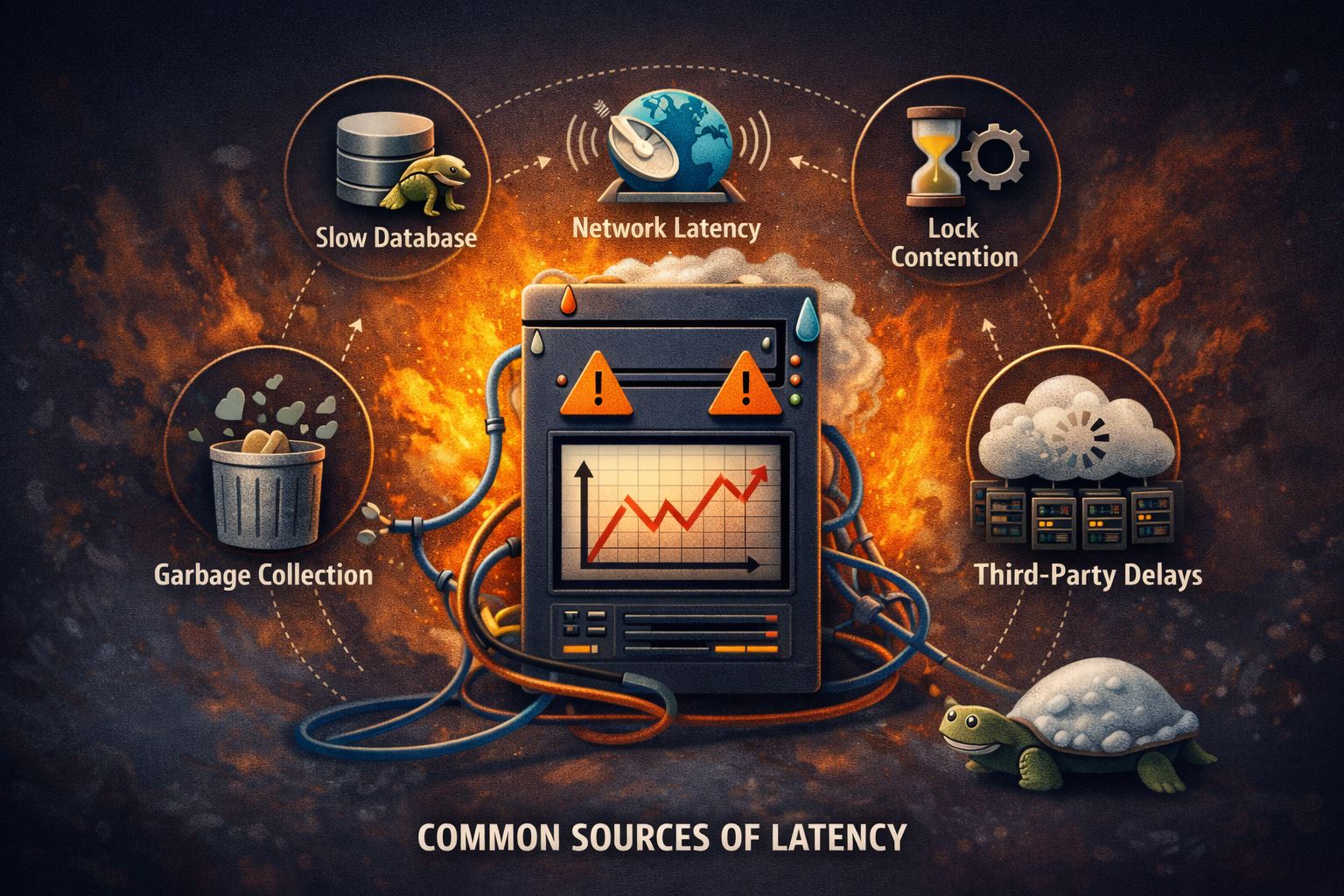
2.1 Network Latency
Every API call is a tax.
- Internal service calls
- Cross-region requests
- DNS lookups
- TLS handshakes
- Retries that multiply everything
One quick internal call can cost 10–30ms.
Chain five of them, and you’ve burned half your latency budget.
Cross-region calls? Add 80–150ms instantly.
You won’t micro-optimize your way out of that.
2.2 Disk I/O
Disk is slower than memory. Always.
Common culprits:
- Database queries
- Cold reads
- Logging at scale
- Synchronous writes
That simple query might be scanning because of a missing index.
That logging statement might be blocking your thread.
When disk is involved, milliseconds evaporate quickly.
2.3 Memory and Allocation
Modern runtimes are fast, until they aren’t.
Excessive allocation leads to:
- Garbage collection pauses
- Memory pressure
- Increased latency variance
You might not see high CPU.
But you’ll see spiky latency.
I’ve seen systems where 90% of tail latency was GC pauses triggered by unnecessary object churn.
Not because the algorithm was slow.
Because we created too much garbage.
2.4 Lock Contention
Threads fighting over shared resources is a silent killer.
- Synchronized blocks
- Shared caches
- Blocking I/O in critical sections
The code looks harmless. But under load, contention explodes.
Throughput collapses, not because work is slow but because threads are waiting.
2.5 External Dependencies
Third-party APIs. Payment gateways. Identity providers.
You don’t control them.
If they slow down, you slow down.
Worse: cascading slowdowns.
A 300ms dependency turns into:
- Thread pool exhaustion
- Increased queue times
- Retry storms
- System-wide latency spikes
Most real-world slowness is I/O-bound, not CPU-bound.
That’s not theory. That’s incident review reality.
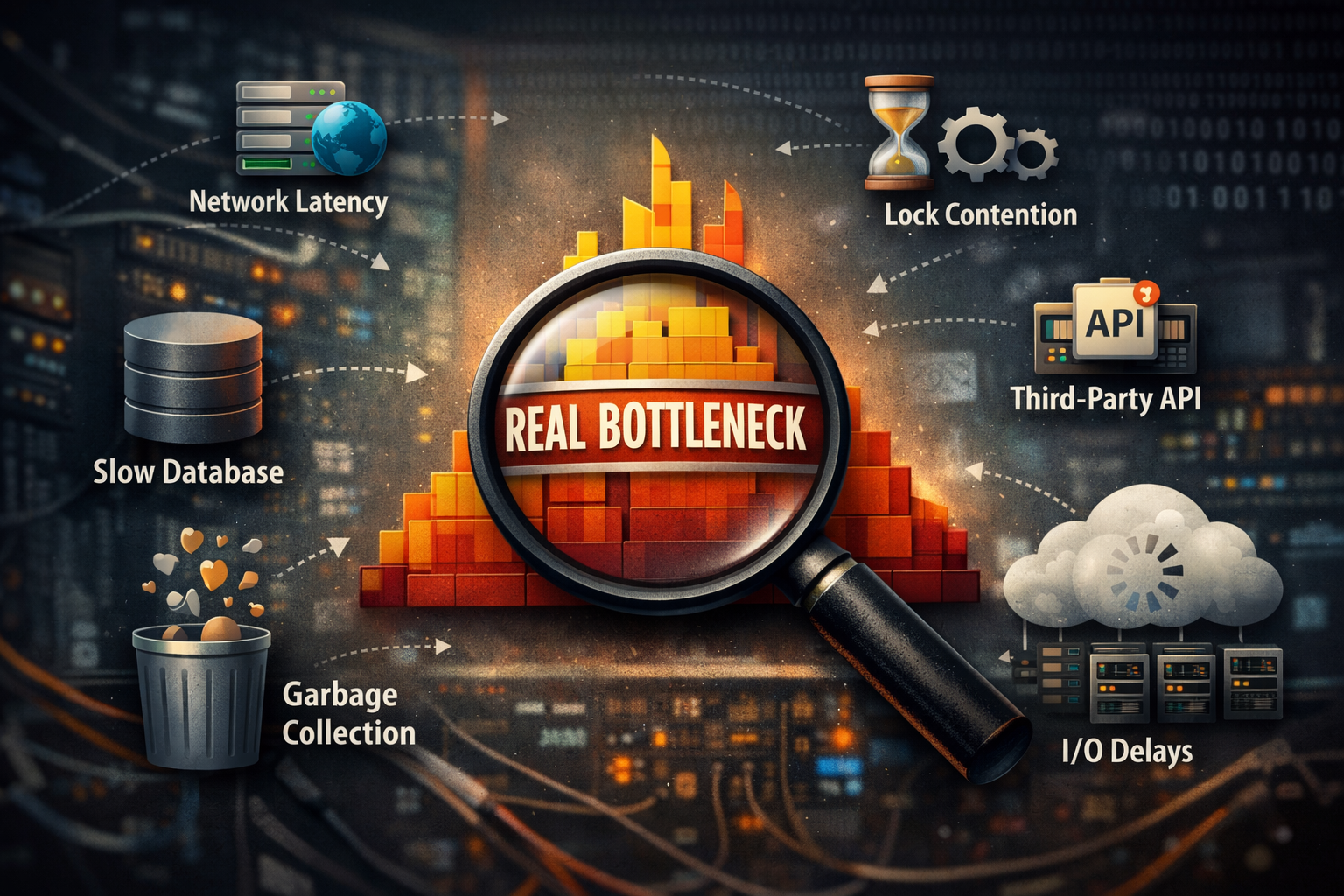
3. The Micro-Optimization Trap
Premature optimization isn’t just about doing things too early.
It’s about optimizing the wrong thing entirely.
Common traps:
- Refactoring code for performance without measurements
- Rewriting services in a faster language while keeping the same architecture
- Replacing simple loops with complex stream pipelines because they look faster
I’ve seen engineers replace a readable loop with a clever chain of transformations. It was harder to understand and functionally identical in performance.
Or manual memory tricks that saved 2ms in isolation inside a request that spent 400ms waiting on a database.
Clever code is often slower to maintain and barely faster to execute.
Performance engineering is not about showing off.
It’s about removing friction from the system.
4. Profiling: The Only Honest Approach
Your intuition is not a profiler.
Measurement beats guessing. Every time.
There are three core tools every serious engineer should understand:
CPU Profiling
Shows where CPU time is actually spent.
You’ll often discover:
- The slow function is insignificant
- Serialization or JSON parsing dominates
- Logging frameworks consume more time than expected
Memory Profiling
Reveals:
- Allocation hotspots
- Object churn
- Leaks
- GC-heavy paths
Sometimes the problem isn’t speed, it’s pressure.
Flame Graphs
Flame graphs visualize stack traces aggregated over time.
They show:
- Which code paths dominate execution
- How deep the stack is
- Where time accumulates
They’re humbling.
You think you know where time goes. Then you see the graph.
You can’t optimize what you haven’t measured.
And you can’t trust what you haven’t visualized.
Profiling turns performance from opinion into fact.
5. What Actually Works in Practice
After enough production incidents, patterns emerge.
Here’s what consistently moves the needle.
5.1 Reduce Network Calls
Reduce chattiness.
- Batch requests
- Aggregate endpoints
- Cache strategically
- Avoid sequential dependency chains
Five 20ms calls are worse than one 30ms call.
Network reduction often yields double-digit percentage improvements.
5.2 Fix Database Access
Databases are common bottlenecks.
Practical wins:
- Proper indexing
- Avoiding N+1 queries
- Query analysis and execution plans
- Eliminating unnecessary joins
An index can outperform any code optimization you could write.
5.3 Eliminate Unnecessary Work
Many systems do more work than required.
Examples:
- Recomputing values that don’t change
- Serializing unused fields
- Fetching full objects when partial data is enough
Remove the work entirely.
Zero milliseconds is faster than optimized milliseconds.
5.4 Improve Architecture Before Code
If heavy computation runs on the request path, you’re already in trouble.
Real improvements come from:
- Moving work to background queues
- Introducing async processing
- Precomputing expensive results
- Decoupling services
Architecture decisions have larger performance impact than micro-optimizations ever will.
6. Latency as a Budget
Treat latency like money.
If your SLA is 200ms, that’s your budget.
Now allocate it:
- API gateway: 10ms
- Service logic: 40ms
- Database: 50ms
- External API: 60ms
- Buffer: 40ms
If one dependency suddenly takes 120ms, the entire system violates SLA.
Small inefficiencies compound.
Five minor 10ms delays add up to 50ms.
Senior engineers think in budgets, not isolated functions.
7. Performance as a Systems Problem
Modern applications are distributed systems.
Performance depends on:
- Networking behavior
- OS scheduling
- Runtime internals
- Container limits
- Infrastructure configuration
You can’t optimize effectively if you only understand your function.
Senior engineers zoom out.
They ask:
- Where does the request travel?
- What does it touch?
- What waits on what?
Optimization becomes about flow, not code.
8. A Practical Optimization Mindset
Here’s the simplest reliable model I’ve used:
- Measure
- Identify bottleneck
- Change one thing
- Measure again
- Stop when improvement plateaus
Discipline matters.
Change one variable at a time.
Don’t refactor the world just in case.
Stop when the system meets its goals.
Over-optimizing wastes time and increases complexity.
Performance work is not about squeezing every nanosecond.
It’s about meeting real constraints reliably.
Conclusion
Most performance optimizations fail because they’re guesses.
They focus on code when the problem lives in the system.
They chase elegance instead of bottlenecks.
In real production systems, the slow parts are usually:
- Network
- Disk
- Dependencies
- Architecture decisions
Not your loop.
Performance engineering isn’t about clever tricks.
It’s about clarity. Measurement. Restraint.
And understanding the system as a whole.
Performance is not about writing faster code. It’s about removing the slow parts of the system.