Introduction
Imagine an AI assistant that answers a simple question correctly 99% of the time.
Sounds impressive.
Now imagine that 1% of the time it confidently invents information, recommends something unsafe, or provides a completely fabricated answer that sounds believable.
Which part do users remember?
Not the 99%.
The 1%.
That is one of the biggest misunderstandings in modern AI discussions. Most conversations focus on accuracy. Most production problems come from reliability.
Every few months, a new model appears with higher benchmark scores, better reasoning evaluations, and improved performance across dozens of tasks. These improvements matter. Better models unlock new capabilities and improve overall quality.
But users rarely experience benchmark scores.
They experience behavior.
They experience whether the system can be trusted.
They experience whether the AI behaves predictably when things go wrong.
And that's where guardrails become more important than another incremental improvement in accuracy.
If you've built AI-powered products, you've probably learned this lesson quickly. The challenge is often not making the model smarter. The challenge is making the system dependable enough that users feel comfortable relying on it.
This article explores why guardrails are often more important than accuracy when building production AI systems and why trust, reliability, and safety ultimately determine whether users adopt an AI product.
1. The Industry's Obsession With Accuracy
The AI industry loves metrics.
We compare models using:
- Benchmark scores
- Leaderboards
- Evaluation datasets
- Reasoning tests
- Coding assessments
- Domain-specific accuracy metrics
These measurements are useful.
Without them, we would have no consistent way to evaluate progress.
A model that scores higher on well-designed evaluations is generally more capable than one that scores lower.
The problem is that capability isn't the same thing as product quality.
A highly accurate model can still create a frustrating user experience.
Consider a model that:
- Hallucinates once every hundred responses
- Occasionally produces unsafe outputs
- Behaves inconsistently between identical requests
- Expresses uncertainty poorly
- Sounds confident when it's wrong
From a benchmark perspective, the model may look exceptional.
From a user perspective, it may feel unreliable.
The gap exists because accuracy measures how often a model gets things right.
Users care about what happens when it gets things wrong.
That's where trust is won or lost.
A useful way to think about it is:
Accuracy measures capability.
Guardrails protect users from capability failures.
The smartest model in the world still needs mechanisms that prevent rare failures from becoming costly failures.
2. The Trust Problem
Trust is difficult to build and remarkably easy to destroy.
Humans are surprisingly forgiving of mistakes when they understand the limitations of a system.
What they struggle with is unpredictability.
If a calculator occasionally returns the wrong answer, nobody trusts it.
If a search engine occasionally invents websites that don't exist, confidence drops quickly.
The same principle applies to AI.
Users naturally assume that confident language implies confidence in correctness.
Unfortunately, modern AI systems are often capable of sounding extremely certain while being completely wrong.
That creates a trust problem.
One bad interaction can outweigh hundreds of successful ones.
Think about GPS navigation.
Imagine a GPS that successfully guides you to your destination every day for a year.
Then one afternoon it suddenly directs you into a lake.
How much confidence would you have the next time you used it?
Probably far less than before.
AI products face the same challenge.
Users don't evaluate reliability statistically.
They evaluate reliability emotionally.
The memory of a serious failure often becomes stronger than the memory of many successful interactions.
That's why reducing catastrophic failures often creates more value than slightly improving average-case performance.
3. What Are AI Guardrails?
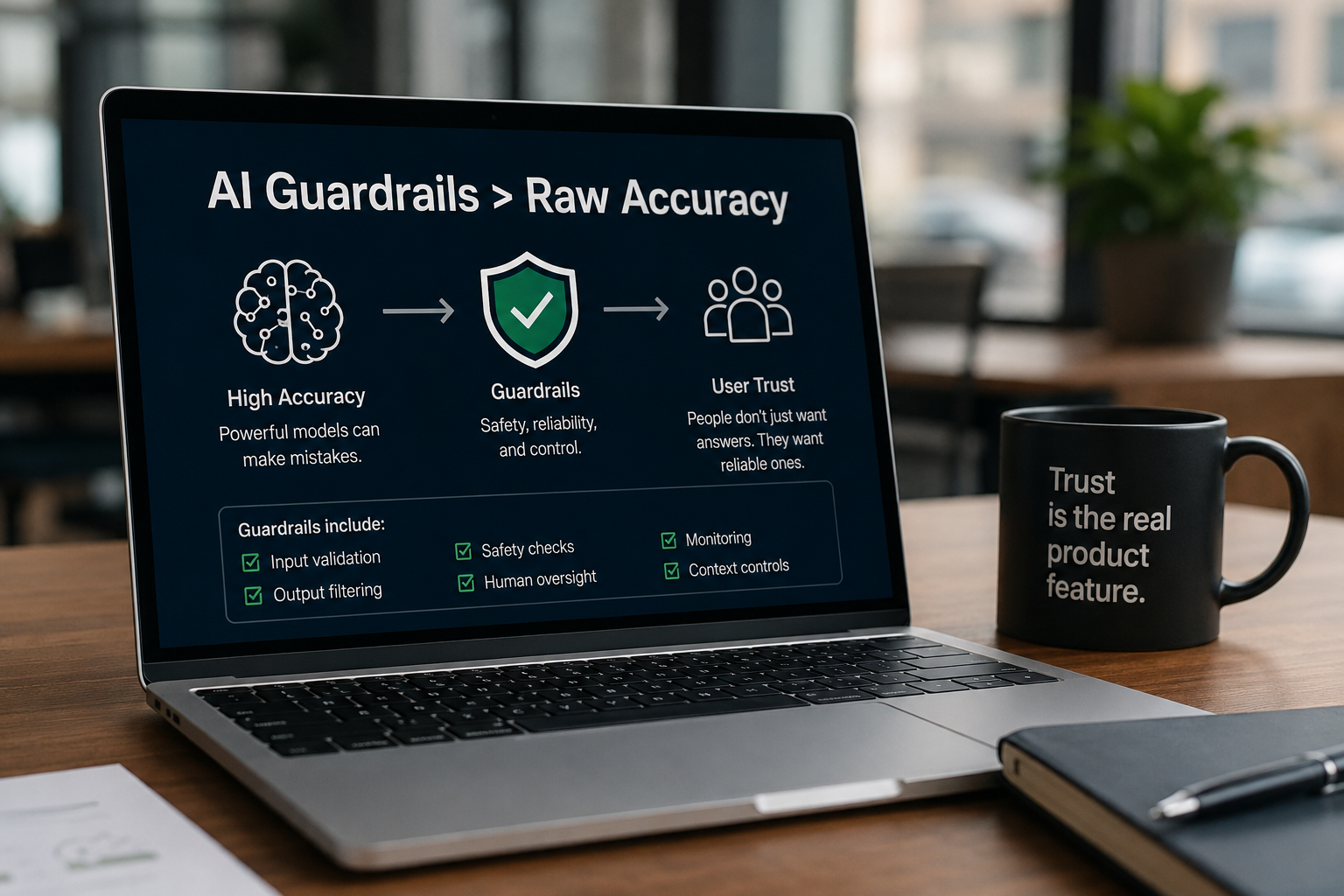
The term "guardrails" gets used frequently, but it's often poorly defined.
In practical engineering terms, guardrails are mechanisms that guide, constrain, monitor, or validate AI behavior.
They exist to reduce risk and improve reliability.
Examples include:
- Content filtering
- Safety checks
- Input validation
- Output validation
- Human review workflows
- Permission controls
- Context restrictions
- Policy enforcement
- Fact verification layers
A common misconception is that guardrails limit AI capabilities.
In reality, guardrails make capabilities usable.
Consider an autonomous vehicle.
Seat belts don't make the car slower.
Brakes don't reduce engine power.
Airbags don't make the vehicle less advanced.
They make it safe enough to operate in the real world.
Guardrails serve a similar purpose for AI systems.
They transform raw intelligence into dependable behavior.
4. Accuracy vs Reliability
Accuracy and reliability are related, but they are not the same thing.
Accuracy asks:
Can the model generate the correct answer?
Reliability asks:
Can the system consistently behave safely and predictably?
Those are very different questions.
Imagine two systems.
System A
- 98% accurate
- Occasionally produces dangerous outputs
- Sometimes ignores instructions
- Rarely admits uncertainty
System B
- 94% accurate
- Consistently follows safety policies
- Clearly communicates uncertainty
- Behaves predictably
In many production environments, System B is the better product.
Why?
Because users can build mental models around predictable behavior.
Unpredictability creates risk.
Risk creates hesitation.
Hesitation reduces adoption.

The reality is that businesses rarely lose customers because their AI answered 94% correctly instead of 98%.
They lose customers because the AI did something surprising, unsafe, or embarrassing.
Reliability often matters more than peak performance.
5. The Hidden Cost of Hallucinations
Hallucination is the AI industry's somewhat polite term for making things up.
In practice, hallucinations can take several forms:
- Fabricated facts
- Invented statistics
- Fake citations
- Imaginary sources
- Incorrect summaries
- Nonexistent product information
The dangerous part isn't simply being wrong.
Humans are wrong all the time.
The dangerous part is being wrong confidently.
Users frequently assume that if an answer sounds detailed and authoritative, it must be accurate.
That assumption becomes problematic in high-stakes environments.
Healthcare
An incorrect recommendation could influence treatment decisions.
Finance
A fabricated regulation or investment claim could affect financial choices.
Legal Systems
An invented case citation could undermine legal work.
Enterprise Software
A hallucinated database query or operational recommendation could cause real business damage.
The challenge is that many users lack the expertise needed to verify every answer.
They depend on the system to know its own limitations.
Guardrails help enforce those limitations.
Without them, hallucinations become production risks rather than isolated model errors.
6. Guardrails as a User Experience Feature
When people hear "guardrails," they often think about compliance, safety, or risk management.
But guardrails are also a user experience feature.
Good guardrails create better interactions.
Consider the following responses:
Response A
A confident but incorrect answer.
Response B
"I don't have enough information to answer that confidently."
Which response creates a better long-term experience?
Usually Response B.
Users appreciate honesty.
They may not enjoy hearing "I don't know," but they dislike being misled even more.
Guardrails improve UX by encouraging behaviors such as:
- Clarifying ambiguous requests
- Asking follow-up questions
- Expressing uncertainty
- Refusing unsupported actions
- Limiting risky recommendations
Ironically, many AI products become more trustworthy when they answer fewer questions.
Knowing when not to answer is often as important as knowing how to answer.
7. How Real AI Products Use Guardrails
Production AI systems rarely consist of a single model receiving a prompt and generating a response.
Modern AI products are usually collections of interconnected systems.
The model is only one component.
Input Guardrails
Before the request reaches the model, systems often perform:
- Prompt validation
- Abuse detection
- Context filtering
- Data classification
- Policy checks
These mechanisms help prevent problematic requests from reaching the model.
Output Guardrails
After generation, additional systems may perform:
- Toxicity detection
- Fact verification
- Sensitive data detection
- Policy compliance checks
- Structured response validation
Many organizations never expose raw model outputs directly to users.
Outputs pass through multiple validation layers first.
Operational Guardrails
Production systems also rely on operational protections such as:
- Rate limiting
- Usage monitoring
- Audit logging
- Escalation workflows
- Human review queues
- Incident response processes
These controls aren't AI-specific.
They're reliability engineering applied to AI systems.
And they're often responsible for more production stability than the model itself.
8. The Engineering Mindset Shift
Traditional software engineering trains us to think in deterministic terms.
Given an input, we expect a predictable output.
If the same code runs twice, we expect the same result.
AI systems break that mental model.
They are probabilistic.
Behavior can vary.
Outputs can change.
Edge cases are harder to enumerate.
That requires a different engineering mindset.
Instead of assuming perfect correctness, engineers must focus on:
- Risk reduction
- Failure containment
- Behavioral monitoring
- Observability
- Recovery mechanisms
The question changes from:
How do we eliminate failures?
To:
How do we ensure failures are safe when they happen?
This shift feels uncomfortable at first.
But it's the same philosophy used in distributed systems, cloud infrastructure, and large-scale reliability engineering.
Failures are inevitable.
The goal is controlling their impact.
9. Building AI Systems People Can Trust
Trustworthy AI products usually follow a few consistent principles.
Be Honest About Uncertainty
If confidence is low, communicate it.
Users generally prefer transparency over false confidence.
Fail Safely
When uncertainty becomes high, choose the safer outcome.
A graceful refusal is often better than a harmful answer.
Verify Critical Outputs
Important decisions should not depend entirely on model-generated content.
Use validation layers whenever possible.
Monitor Real User Behavior
Benchmarks are useful.
Production behavior is more important.
Observe where users struggle, lose trust, or encounter unexpected results.
Design for Human Oversight
Humans should remain part of high-risk workflows.
The goal isn't replacing judgment.
It's augmenting it.
The most successful AI products usually combine automation with human supervision rather than attempting to eliminate oversight entirely.
10. The Future of AI Isn't Smarter Models Alone
Model intelligence will continue improving.
That's almost guaranteed.
But intelligence alone won't solve the biggest production challenges.
The next wave of progress will come from:
- Better orchestration
- Better monitoring
- Better verification systems
- Better safety mechanisms
- Better trust frameworks
- Better user experience design
The companies that succeed won't necessarily have the smartest models.
They'll have the most dependable systems.
Because in the real world, users don't judge AI based on benchmark rankings.
They judge it based on whether it helps them accomplish tasks safely, reliably, and predictably.
Trust becomes the competitive advantage.
Not raw intelligence.
Conclusion
Accuracy matters.
Nobody wants an AI system that performs poorly.
But accuracy alone doesn't create trust.
And trust is ultimately what determines whether people continue using an AI product.
Users don't experience benchmark scores.
They experience behavior.
They experience whether the system admits uncertainty.
They experience whether it handles edge cases gracefully.
They experience whether it behaves predictably when things go wrong.
That's why guardrails are not optional infrastructure wrapped around AI systems.
They are part of the product itself.
As AI becomes more deeply integrated into everyday software, the winners won't simply be the organizations with the most capable models.
They'll be the organizations that make those models trustworthy.
The future of AI won't be defined by the models that know the most.
It will be defined by the systems people trust the most.